
Technical Resources
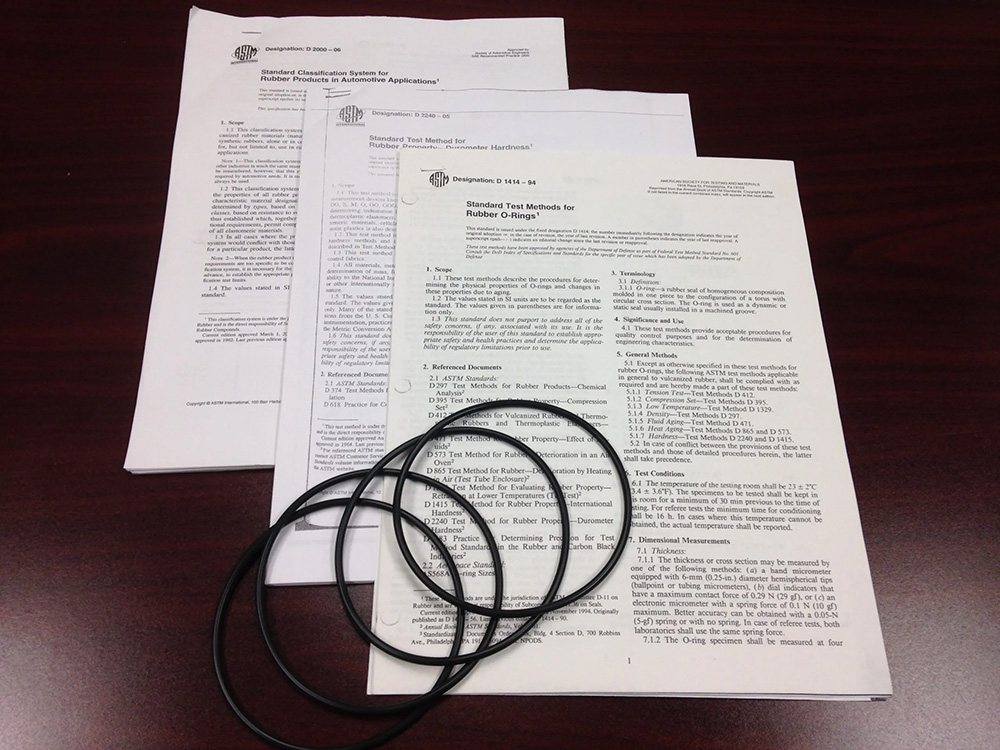
McMasters Koss provides complete compliance to ASTM and other industry standard specifications.
McMasters Koss offers a wide selection of elastomers and certifications to meet both Military (Mil Spec) and Aerospace specifications. We supply materials that comply with a range of OEM material standards, and our team can provide custom testing to satisfy your unique requirements. Kits and specialized packaging are also available to suit various applications.
Contact our sales engineering team today to discuss your specific needs and discover how McMasters Koss can deliver solutions tailored to your exact specifications.
Helpful Information
AS568 Size Chart
Introduced originally in 1958 as ARP568 “Uniform Dash Numbering System for O-Rings” with a combination of ID and Cross-Sectional measurements and tolerances to identify standard sized O-Rings. The AS568 Size and Tolerance chart has been widely used commercially and is in process of being incorporated into all U.S. Military specifications and drawings.
Last revised in 2001 as the AS568B Specification, this revision simplified some tolerances and provided an improved description of how to utilize. The AS568B standard was adopted by the U.S. Department of Defense in 2005 and is expected to be used in future military specifications and incorporated into older ones.
AS568B size chart encompasses 5 different Cross-Sectional sizes and ID measurements from 1/32″ to over 26″ to provide a wide range of sizes that can be utilized in commercial, automotive, heavy duty transportation and industrial applications.
In Addition, 20 boss tube O-Ring sizes are included to provide a range of standard O-Ring sizes for straight thread tube fittings on a boss.
McMasters Koss has supplied O-Rings to automotive manufacturers worldwide meeting the AS568B specification and has inspection teams trained and equipment calibrated to validate conformance of many commercial and Automotive Level 3 PPAP O-Rings.
Please click here to download the pdf version of McMasters Koss AS568 Size chart and contact our sales engineering team for any assistance with your new design or replacement seal application.
Elastomer Compounds
Butyl Elastomer
Butyl Elastomers are typically used in vacuum applications due to exceptional low permeability. Long term storage containers will typically utilize Butyl to minimize leakage over time.
Butyl elastomers have been replaced by EPDM for some general vacuum applications but butyl still provides superior resistance to permeation and stronger resistance to sunlight and ozone.
Butyl is sometimes used in older Skydrol 7000 applications in auxillary power units (APU’s) for cabin pressurization.
Butyl resists heat, steam, silicone base fluids and phospate ester hydraulic fluids.
Butyl CANNOT be used in petroleum, hydrocarbon or fuel applications.
Click Here to reach out to our sales engineering team to discuss your Butyl application
Chloroprene (Neoprene)
Neoprene was one of the first synthetic elastomers created as a result of natural rubber shortages that occurred during World War II.
The methyl group within a natural rubber chain is substituted for a Chlorine atom to give the neoprene elastomer superior resistance to hydrocarbons, ozone, oxygen and UV light.
Other elastomers have largely supplanted Neoprene with the exception of petroleum, automotive and HVAC refrigerant applications.
Neoprene offers superior oil resistance over Nitrile but is still realatively economical for cost sensitive applications
Neoprene function better as a weatherseal than EPDM at similar cost when oil contamination could occur as typical in the petroleum industry.
Different HVAC refrigerant systems require Neoprene or HNBR elastomers instead of the standard Nitrile elastomer previously used in most older systems.
Neoprene has provided an economical alternative for some of the more aggressive HVAC refrigerants.
Click Here to reach out to our sales engineering team with your Neoprene application.
EPDM
A Terpolymer of ethylene, propylene and diene monomer to create Ethylene Propylene Diene Monomer. (EPDM) EPDM has excellent sunlight, ozone and oxygen resistance.
EPDM provides good low temperature resistance and moderate high temperature performance. (-65F to 300F) EPDM performs well in water and can resist even higher temperatures than 300F when in the presence of steam.
EPDM is an excellent weatherseal for wet, humid or dry heat environments. EPDM can be used in automotive interiors, electronic enclosures, or any application where there will be exposure to direct sunlight, oxygen or ozone.
EPDM can perform well in sealed automotive antifreeze coolant applications where there is no contact with petroleum oils or greases.
EPDM provides a cost effective seal for use with a wide variety of drinking water, potable water and pool water applications.
Varieties of EPDM can meet FDA, NSF, WRAS and KTW regulatory requirements.
EPDM can be formulated to provide outstanding resistance to Skydrol and other phosphate ester hydraulic fluids used in aviation hydraulic systems.
EPDM SHOULD NOT BE USED IN PETROLEUM, HYDROCARBON OILS, Di-ESTER BASED LUBRICANTS OR HALOGENATED SOLVENTS
Click Here to reach out to our sales engineering team with your EPDM application.
Ethylene Acrylic (Vamac)
A copolymer of ethylene and methyl acrylate offering resistance to ozone, sunlight and moderate temperatures. (-40F to +300F)
Ethylene Acrylic offers low gas permeability and moderate oil swell resistance.
Typically used in automotive transmission and power steering applications due to compatibility with typical transmssion fluids and good wear and abrasion resistance.
ETHYLENE ACRYLIC IS NOT RECOMMENDED FOR PETROLEUM OILS, ALIPHATIC OR AROMATIC HYDROCARBONS, DI-ESTER BASED LUBRICANTS OR HALOGENATED SOLVENTS.
Click Here to reach out to our sales engineering team with your Ethylene Acrylic application.
Fluorocarbon (Viton)
Fluorocarbon elastomer or Fluoroelastomers (as commonly called) were originally developed by the Dupont Company and marketed under the trade name of Viton.
Designed with a high strength fluorine-hydrogen bond, this elastomer provides superior resistance to extreme temperatures and a wide variety of chemicals.
Severe service equipment manufacturers quickly adopted fluorocarbon and have utilized it in a wide variety of automotive, industrial, petrochemical and semi-conductor applications.
Fluorocarbon is available in a number of fluorination levels to provide higher levels of chemical or low temperature performance.
Specialty fluorocarbon elastomers have been developed to provide superior performance in specific caustic chemicals and a lower low temperatures.
The standard type A fluorocarbon provide good performance at constant temperatures up to 400F and intermittently up to 600F with moderate low temperature performance.
McMasters Koss has been supplying Fluorocarbon (Viton) O-Rings and seals for over 45 years and offers a strong complement of commercial stock in Brown and Black colors for quick shipment as needed.
McMasters Koss offers fluorocarbon elastomers meeting FDA and 3A Sanitary requirements for food, beverage or drinking water applications. We can assist with NSF new product submission if required.
UL listed fluorocarbon elastomers are available to meet regulatory requirements.
Nace TM0027 and NORSOK approved elastomers provide superior Rapid Gas Decompression (RGD) Resistance for demanding petroleum applications.
McMasters Koss Standard Fluorocarbon Compound Listing:
• HK75XXX – Brown, -15F to +400F, 75 durometer, Stock, General chemical and temperature resistance
• HK75XXX – Black, -15F to +400F, 75 durometer, Stock, General chemical and temperature resistance
• HK75XXX – Green, -15F to +400F, 75 durometer, Stock, General chemical and temperature resistance
• HK90XXX – Black, -15F to +400F, 90 durometer, 10-12 Weeks, High Pressure with General chemical and temperature resistance
• HK60XXX – Black, -15F to +400F, 60 durometer, 10-12 Weeks, Low Pressure with General Chemical and temperature resistance
• HK75XXX – Black, -40F to +350F, 75 durometer, 10-12 Weeks, Low Temperature Applications with moderate chemical and temperature resistance
• HK75XXX – Black, -5F to +400F, 75 durometer, 10-12 Weeks, Superior Chemical Resistance for caustic environments
• HK75XXX – Black, -15 to +350F, 75 durometer, 10-12 Weeks, Superior resistance for basic environments
• HK75XXX – Black, -15 to +400F, 75 durometer, 10-12 Weeks, UL Listed fluorocarbon elastomer
• HK75XXX – Black, -15 to +400F, 75 durometer, 10-12 Weeks, Rapid Gas Decompression Resistant fluorocarbon to meet Nace TM0027
Click Here to reach out to our sales engineering team to discuss your fluorocarbon application.
Fluorosilicone
Fluorosilicone elastomer has low compression set resistance and is typically used in aerospace and automotive fuel systems.
Combining the best properties of Fluorocarbon and Silicone into a hybrid elastomer that is resistant to solvents, fuel and oil with exceptional high and low temperature stability.
Automotive Emission systems also utilize fluorosilicone elastomers to provide long performance life performance over the wide temperature ranges that different vehicle can encounter worldwide.
Automotive Emission systems also utilize fluorosilicone elastomers to provide long performance life performance over the wide temperature ranges that different vehicle can encounter worldwide.
Fluorosilicone is resistant to oxygen, ozone and sunlight exposure for use as weatherseals in difficult applications where typical elastomers might degrade.
Fluorosilicone elastomers are not recommended for Brake Fluid, Hydrazione or ketone applications.
Click Here to reach out to our sales engineering team with your Fluorosilicone application.
Hydrogenated Nitrile (HNBR)
Nitrile elastomer is hydrogenated to replace reactive double bonds with individual hydrogen atoms that create a highly saturated hydrocarbon elastomer (HSN) with superior chemical and temperature resistance.
HNBR can perform in applications from -25F to 300F (150C)
HNBR can be peroxide or platinum cured to provide superior hydrogenation of carbon bonds in the elastomer. This elastomer offers better oil, fuel and temperature resistance than standard Nitrile compounds. HNBR is highly resistant to atmospheric Weathering and ozone.
HNBR is used in deep oil well applications which require resistance to heat, crude oil, industrial lubricants, sour gases, (H2S) hot water and steam.
HNBR is also widely used in modern automotive and residential HVAC refrigerant systems which are derived to reduce environmental impact but are far more caustic on rubber seals within the system.
Specially formulated HNBR compounds can be used in moderate temperature automotive and truck fuel applications.
Click Here to reach out to our sales engineering team to discuss your HNBR application.
Nitrile (Buna N)
Nitrile is the most common elastomer providing excellent oil resistance, wide temperature range and ability to compound a wide variety of special performance properties into the compound to expand the range of applications it can fulfill.
Nitrile has Good Tensile and abrasion resistance for dynamic hydraulic applications and can include a variety of internal and external lubricants to provide superior lubricity and reduced break out friction in dynamic applications.
Nitrile can be compounded to provide very low temperature performance and is the elastomer of choice for low temperature dynamic applications.
Nitrile performs well with petroleum products, silicone oils, ethylene glycol, dilute acids and low temperature water.
Nitrile is not recommended for aromatic hydrocarbons, brake fluid, Halogenated compounds or strong acids.
Click Here to reach out to our sales engineering team to discuss your nitrile application.
Perfluoroelastomers
Perfluoruoroelastomers are fully fluorinated to provide the best chemical and highest temperature resistance of elastomers.
Perfluoroelastomers are used in high purity semiconductor applications where vacuum systems are sensitive to outgassing or contamination that can occur with typical elastomers.
Chemical and Petroleum Processing Applications may require high chemical and temperature resistance.
Rapid Gas Decompression (RGD) resistance in required in many downhole drilling applications.
Perfluoroelastomers are high cost seals due to the full fluorination manufacturing process and high purity requirements for some semiconductor applications.
Perfluoroelastomer compounds are not recommended for use with Uranium Hexafluoride, Fully Halogenated Freon or Fluorinated Solvents
Click Here to reach out to our sales engineering team with your Perfluoroelastomer application.
Silicone
Why do We Use Silicone for O-Rings?
- Wide Temperature Range: Silicone O-rings can typically withstand temperatures from -75°F to +450°F (-59°C to +232°C), making them ideal for extreme hot or cold environments.
- Flexibility and Elasticity: Even at low temperatures, silicone remains flexible, allowing it to maintain an effective seal where other materials might become brittle.
- Chemical Resistance: Silicone offers good resistance to water, ozone, UV light, and many mild chemicals, making it suitable for both indoor and outdoor use.
- Low Toxicity: Food-grade and medical-grade silicone options make these O-rings suitable for use in food processing, pharmaceuticals, and medical devices.
- Color Options: Silicone can be pigmented for easy color coding or identification of material grades.
Common Applications
- Aerospace and aviation
- Automotive components
- Food and beverage processing
- Medical devices
- Electronics enclosures
- High-temperature industrial equipment
Tetrafluoroethylene-Propylene (Aflas)
Aflas is the registered trademark of Asahi Glass for Tetrafluoroethylene-Propylene elastomers.
Aflas offers excellent resistance to chemicals and high temperatures in dry air or steam environments.
Aflas offers high temperature resistance up to 450F
Compatible with bases, phosphate esters, amines, engine oils, steam and hot water.
Aflas is not recommended for aromatic fuels, ketones or chlorinated hydrocarbons.
Click Here to reach out to our sales engineering team with your Aflas application.
Engineered Plastics & Teflon
Polyether Ether Ketone (PEEK)
A thermoplastic with excellent mechanical and chemical resistance properties.
It is resistant to thermal degradation and some varieties can be can be used at temperatures up to 483F. (250C)
PEEK is utilized in bearing, piston, pumps, valves and chromatography column applications.
PEEK is one of the few thermoplastics recommended for high vacuum applications encountered in aerospace, automotive and chemical applications.
PEEK is not recommended for use in halogenated acids, bronsted and Lewis type acids or aliphatic hydrocarbons at high temperatures.
Click Here to contact our sales engineering team about your PEEK application.
Polyurethane
Tetrafluoroethylene (PTFE)
PTFE is created by the radical vinyl polymerization of tetrafluoroethylene (TFE) resulting to create a strong fluorine carbon bonds that are resistant to almost all chemicals and solvents.
PTFE can perform under a very wide range of temperatures, (-300F to 500F) is non-flammable and acts as a thermal and electrical insulator.
PTFE is very slippery by nature and is perfect for applications in which external lubricants cannot be used.
PTFE has no memory and any the PTFE seal will permanently deform under compressive load. (Creep or Cold Flow)
As a result of this, PTFE is sometimes used in conjuction with standard elastomers to protect from any permanent deformation.
PTFE can also be filled with a variety of ingredients to provide better resistance to deformation, stronger physical strength or superior wear resistance.
Fillers like Glass, MoS2, Carbon, Graphite, Bronze, Stainless Steel and others can be used to resist Creep, improve wear resistance, and allow thermal or electrical conductivity.
The lack of chemical reactivity of PTFE products, ease of sterizilation, lubricity and hydrophillic properties a wide variety of medical products to use PTFE components.
PTFE can also be coated to a variety of elastomer, or metal components to provide superior performance over standard materials.
PTFE CANNOT BE USED IN FLUORINE, CHLORINE TRIFLUORIDE OR MOLTEN ALKALI SOLUTIONS AT HIGH TEMPERATURES.
Click Here to reach out to our sales engineering team with your PTFE application.
Ultra High Molecular Weight Polyethylene (UHMWPE)
A long chain polyethylene material with same direction alignment to provide excaptional resistance to impact or abrasion. This material has the characteristics of a high density polyethylene (HDPE) with the added traits of being resistant to concentrated acids and alkali.
UHMWPE offer low moisture absorption and is generally ideal for dynamic applications due to low coefficient of friction, high abrasion resistance and self lubricating (boundary lubricating) properties.
Click Here to reach out to our sales engineering team to discuss your HDPE or UHMWPE application.